Figures
Interactive demo — coming soon.
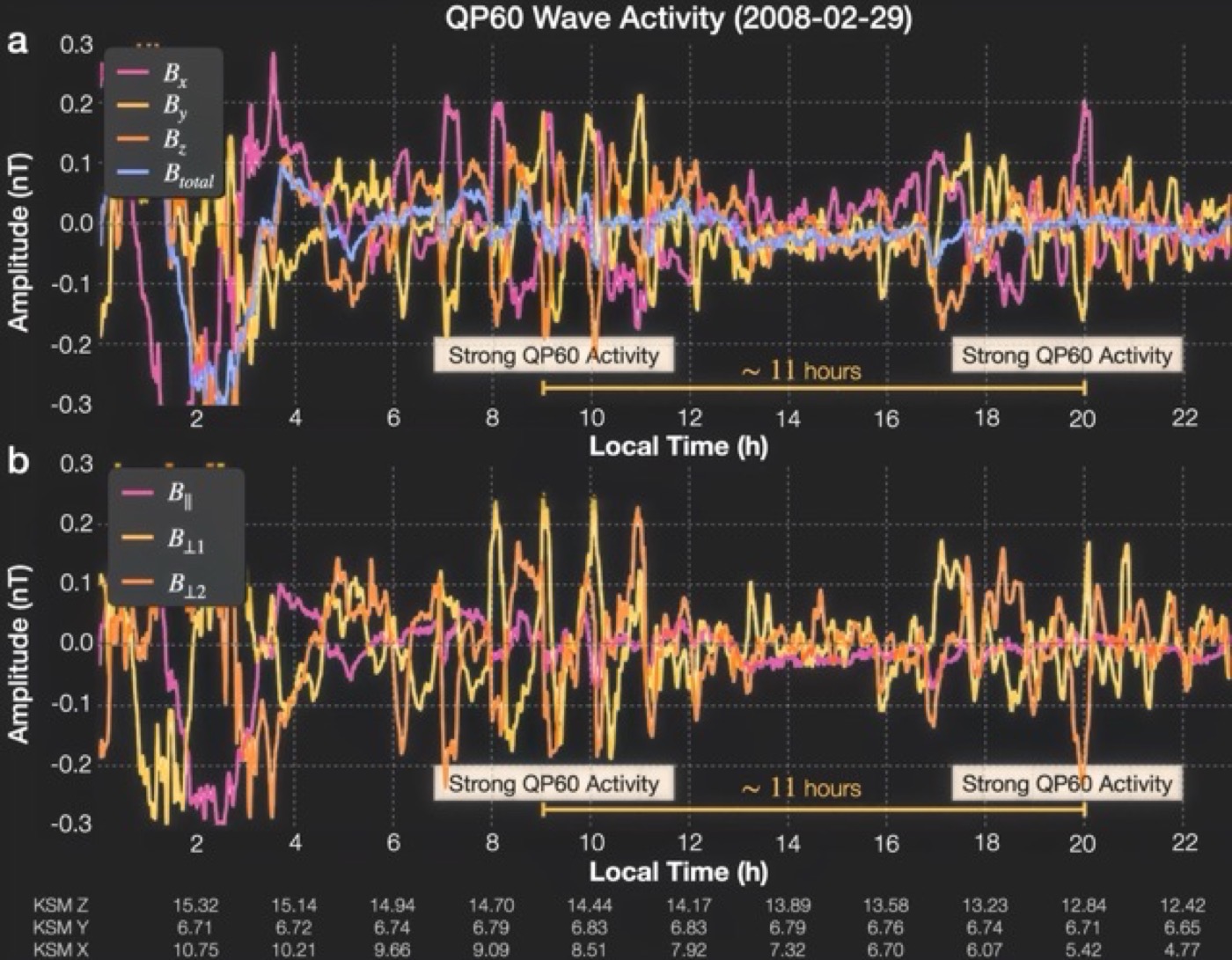
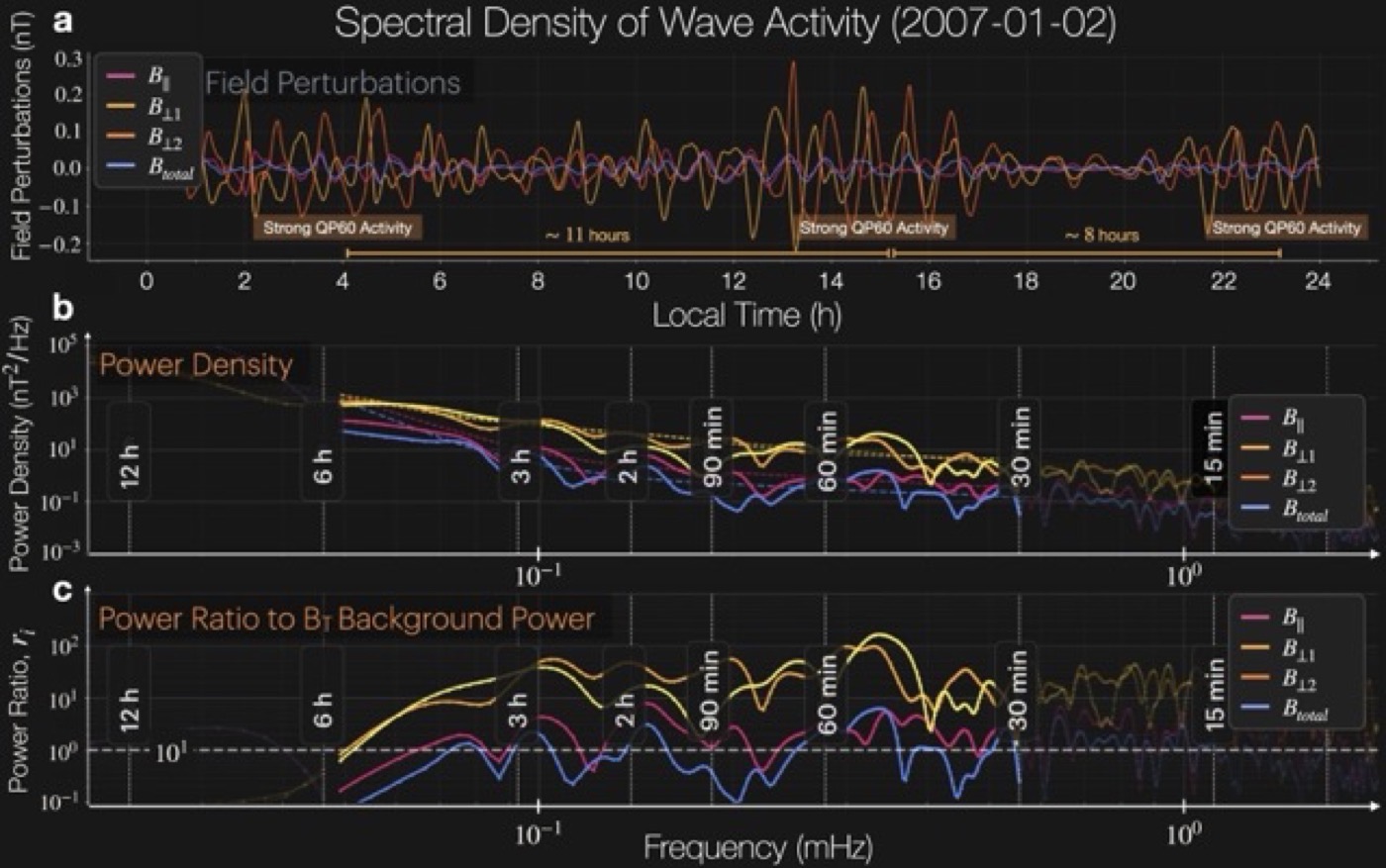
1-hour waves have been observed around Saturn for a long time, but their origin remains poorly understood. We study them as resonances of Saturn's magnetic field — like a plucked guitar string vibrating at its natural frequency. Approximating Saturn's field as a bar magnet is not enough to reproduce 1-hour waves across the large regions far outside the planet; using a realistic plasma mass density along the field, the higher harmonics of these vibrations match the observed 1-hour period.
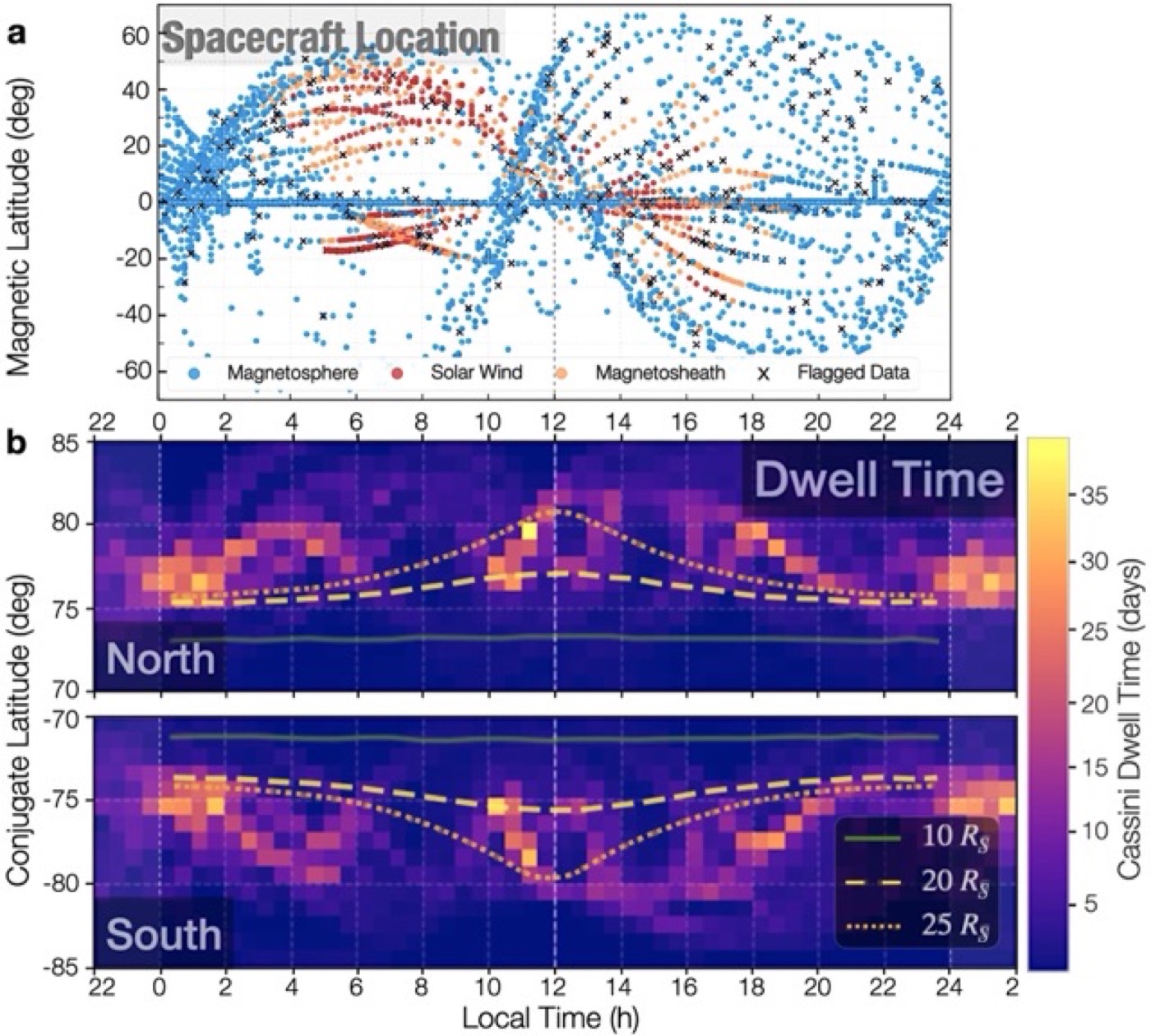
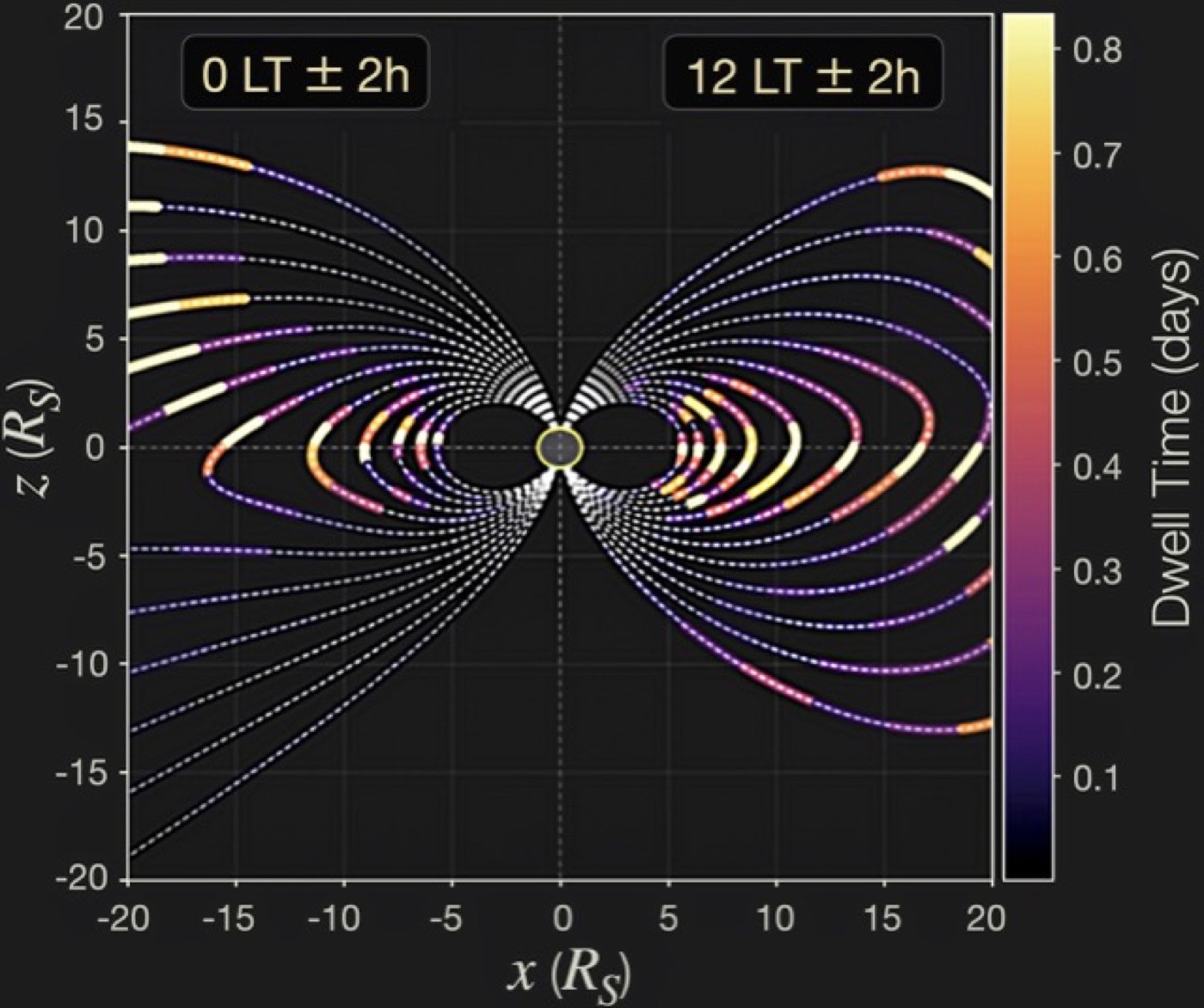
We model the omnipresent quasiperiodic 60 min waves in Saturn's outer magnetosphere as field line resonances adopting a realistic magnetic field model and a measurement-based plasma density distribution using Alfvén wave resonance theory for arbitrary field geometries (Singer et al., 1981). The modeled eigenfrequencies for the second and higher modes are roughly independent of invariant latitude, mapping into large regions of the magnetosphere up to at least 20 RS, and the third and fourth harmonic modes having close to 1 h eigenperiod. The model predicts the normalized amplitudes of these higher modes of the magnetic field perturbations at high latitudes to exceed the amplitudes at the plasma sheet, in agreement with the observations of more frequent occurrences at mid-to-high latitudes. The periods of the higher order field line resonances in the outer magnetosphere differ considerably from those in a dipole model, illustrating the importance of a realistic field model.
Interactive demo — coming soon.