Figures
Interactive demo — coming soon.
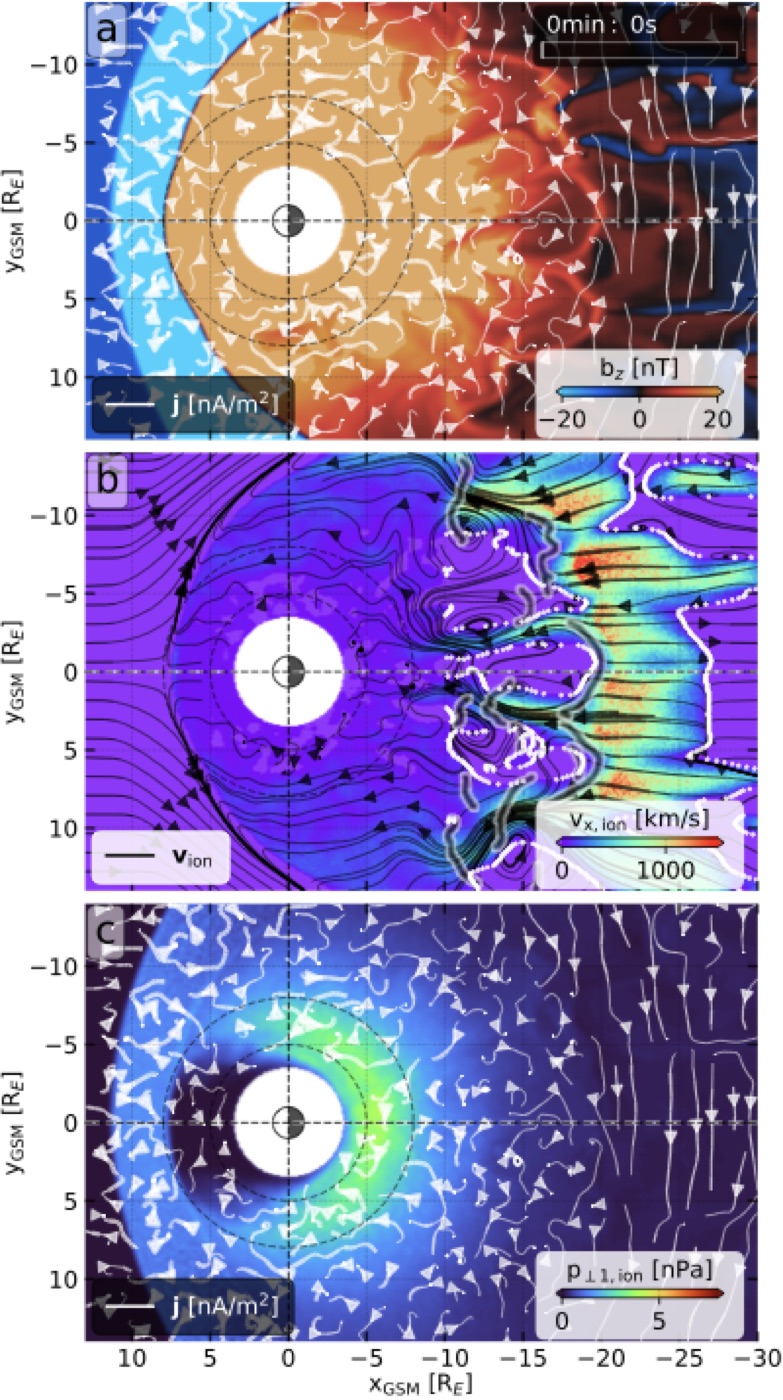
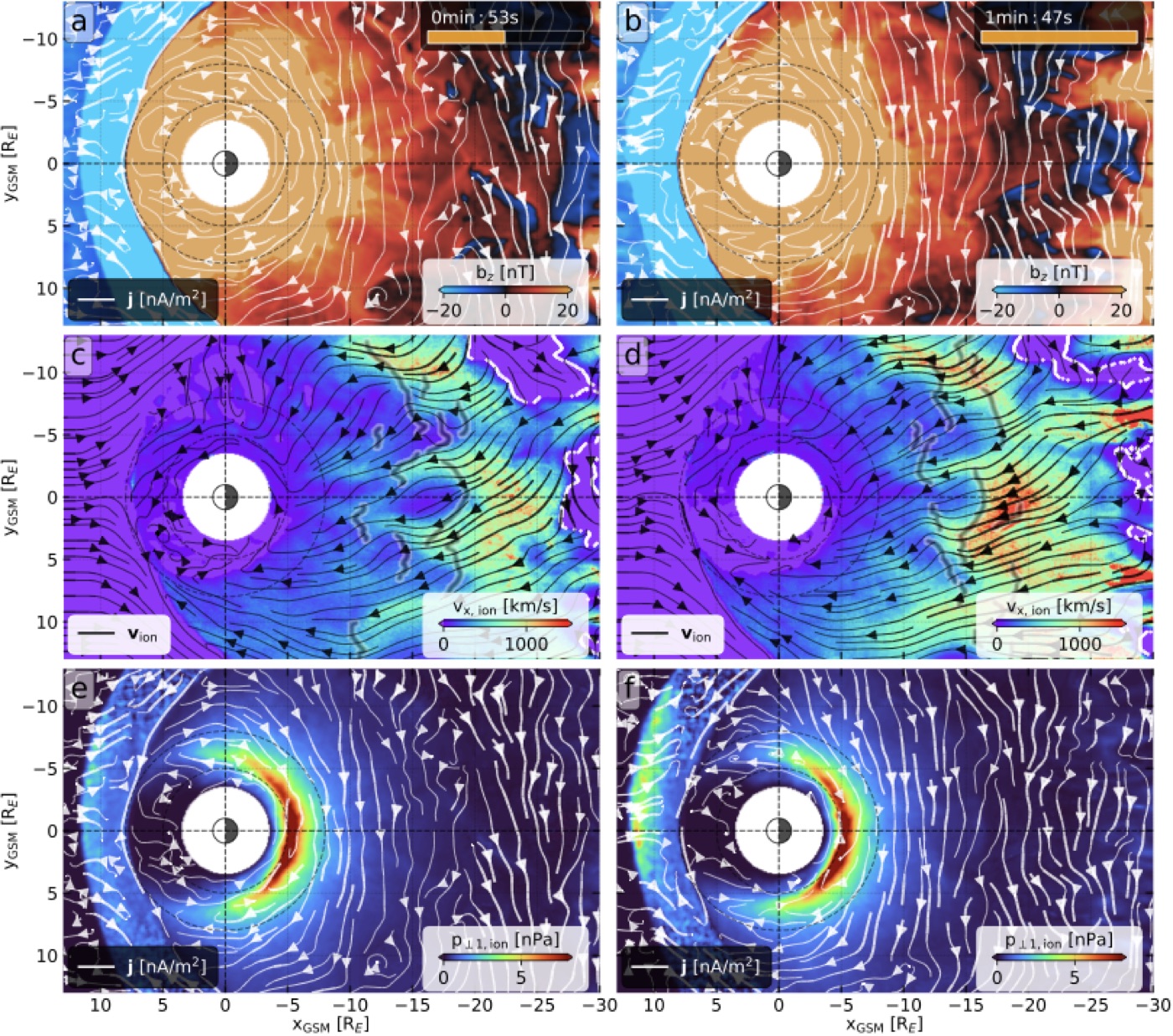
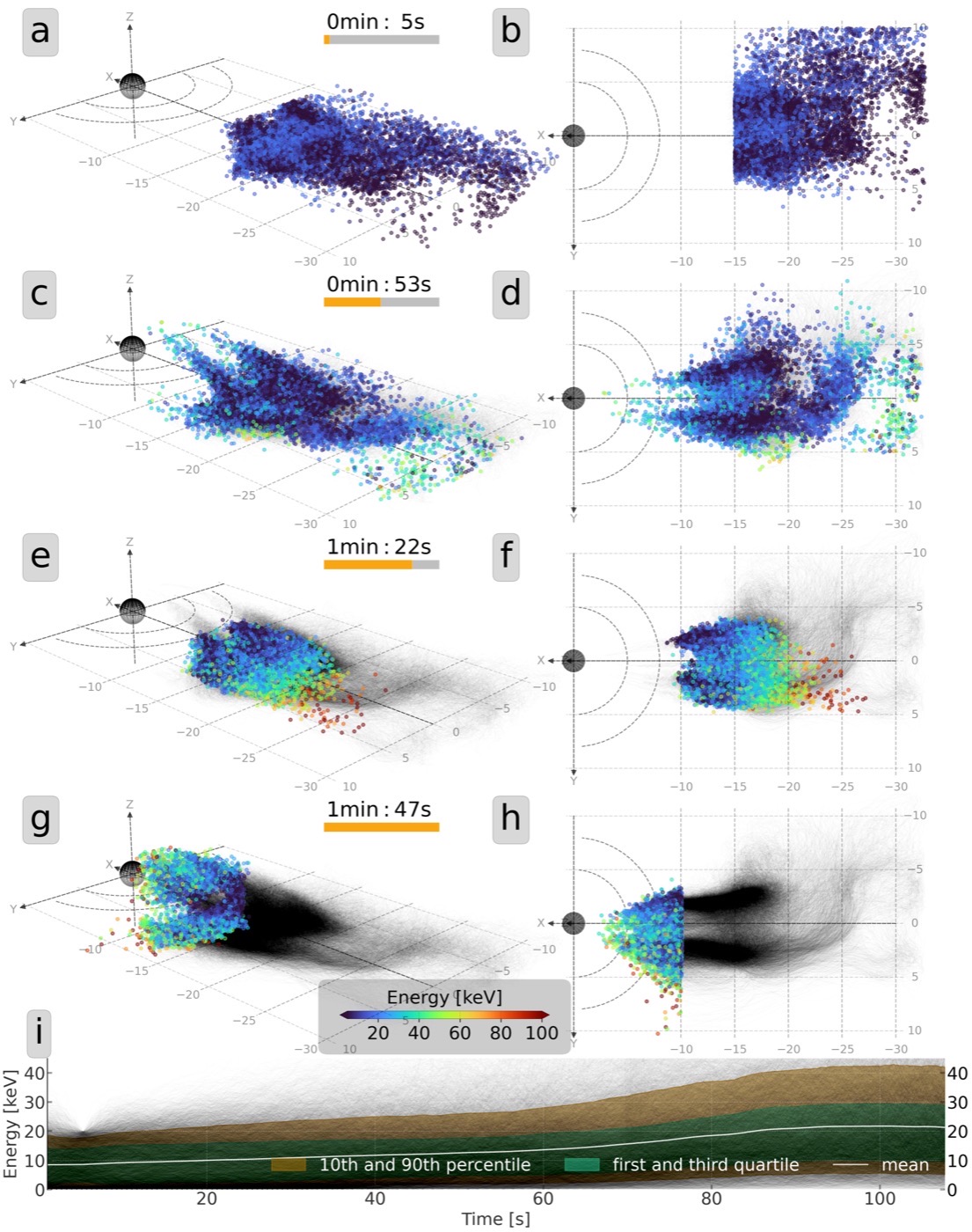
During intervals of increased solar activity, the magnetic field in Earth's stretched night-side tail reconfigures intensely and energizes particles — magnetic reconnection. We simulate this with a model that couples Earth's global field configuration to a self-consistent kinetic treatment of both electrons and ions, and find that particles accelerated near the reconnection sites (ions gaining tens of keV) propagate earthward and contribute to a partial ring current encircling Earth.
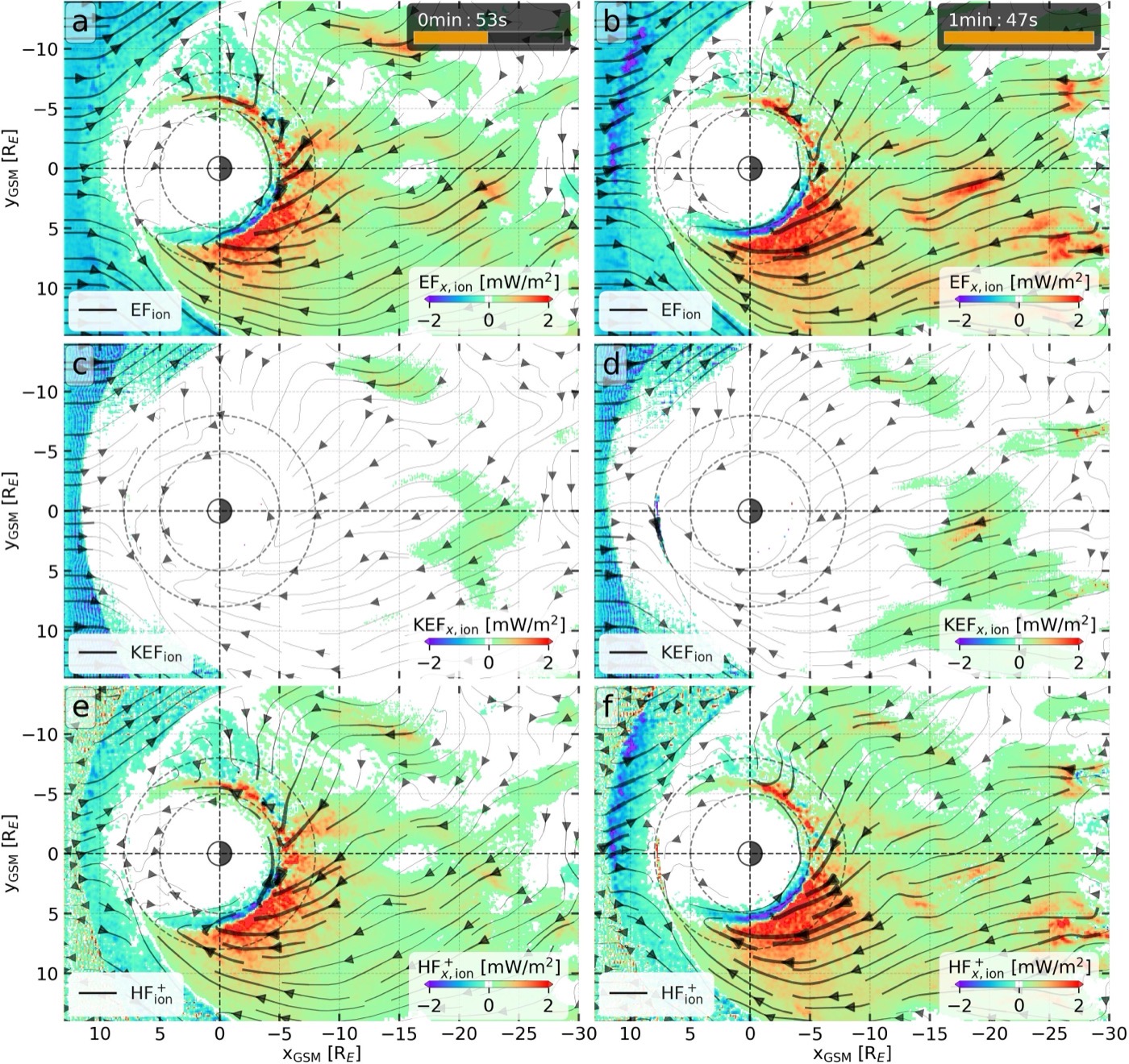
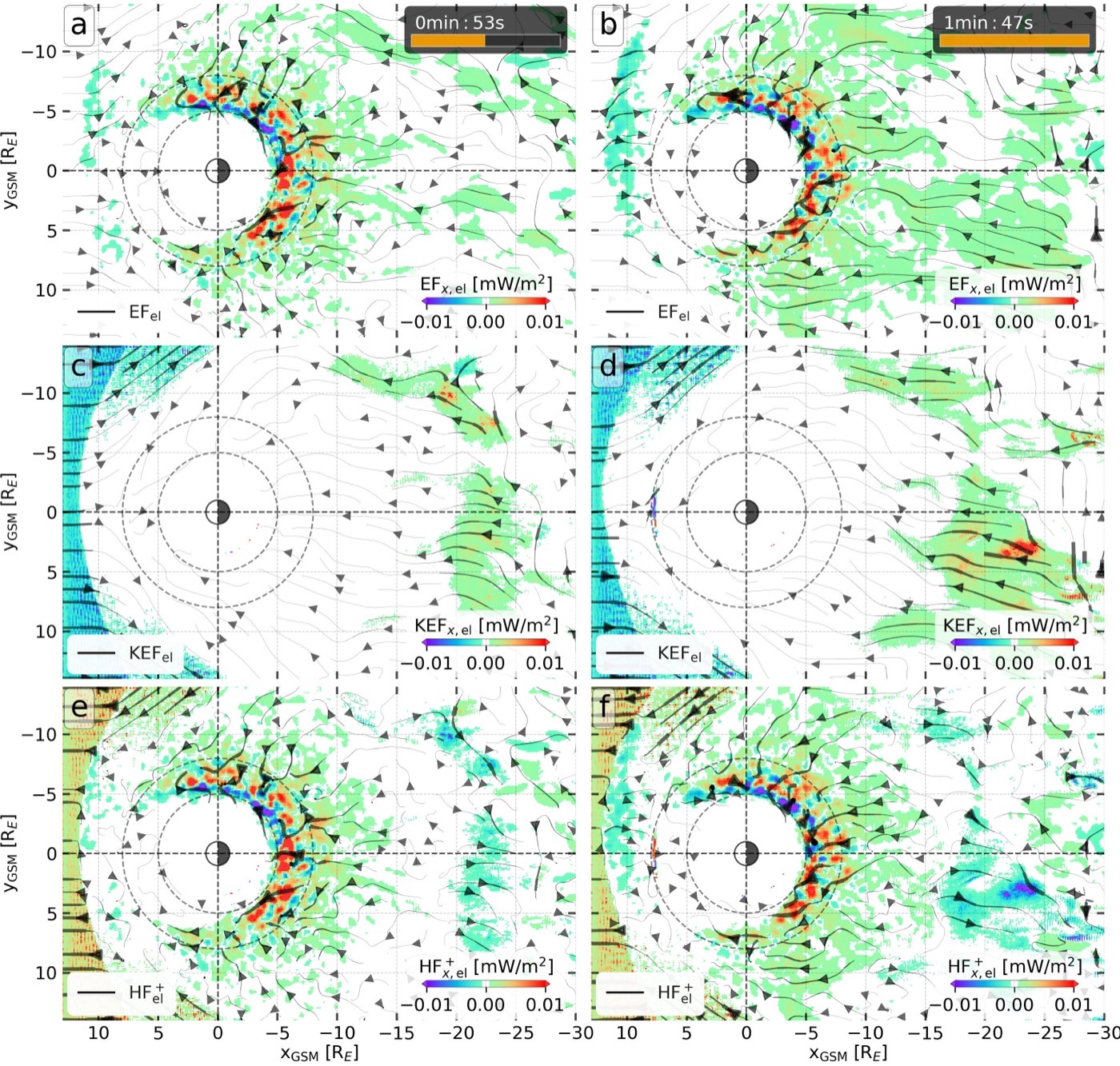
During magnetospheric substorms, plasma from magnetic reconnection in the magnetotail is thought to reach the inner magnetosphere and form a partial ring current. We simulate this process using a fully kinetic 3D particle-in-cell (PIC) numerical code along with a global magnetohydrodynamics (MHD) model. The PIC simulation extends from the solar wind outside the bow shock to beyond the reconnection region in the tail, while the MHD code extends much further and is run for nominal solar wind parameters and a southward interplanetary magnetic field. By the end of the PIC calculation, ions and electrons from the tail reconnection reach the inner magnetosphere and form a partial ring current and diamagnetic current. The primary source of particles to the inner magnetosphere is bursty bulk flows (BBFs) that originate from a complex pattern of reconnection in the near-Earth magnetotail at xGSM = −18 RE to −30 RE. Most ion acceleration occurs in this region, gaining from 10 to 50 keV as they traverse the sites of active reconnection. Electrons jet away from the reconnection region much faster than the ions, setting up an ambipolar electric field allowing the ions to catch up after approximately 10 ion inertial lengths. The initial energy flux in the BBFs is mainly kinetic energy flux from the ions, but as they move earthward, the energy flux changes to enthalpy flux at the ring current. The power delivered from the tail reconnection in the simulation to the inner magnetosphere is > 2×10¹¹ W, which is consistent with observations.
Interactive demo — coming soon.